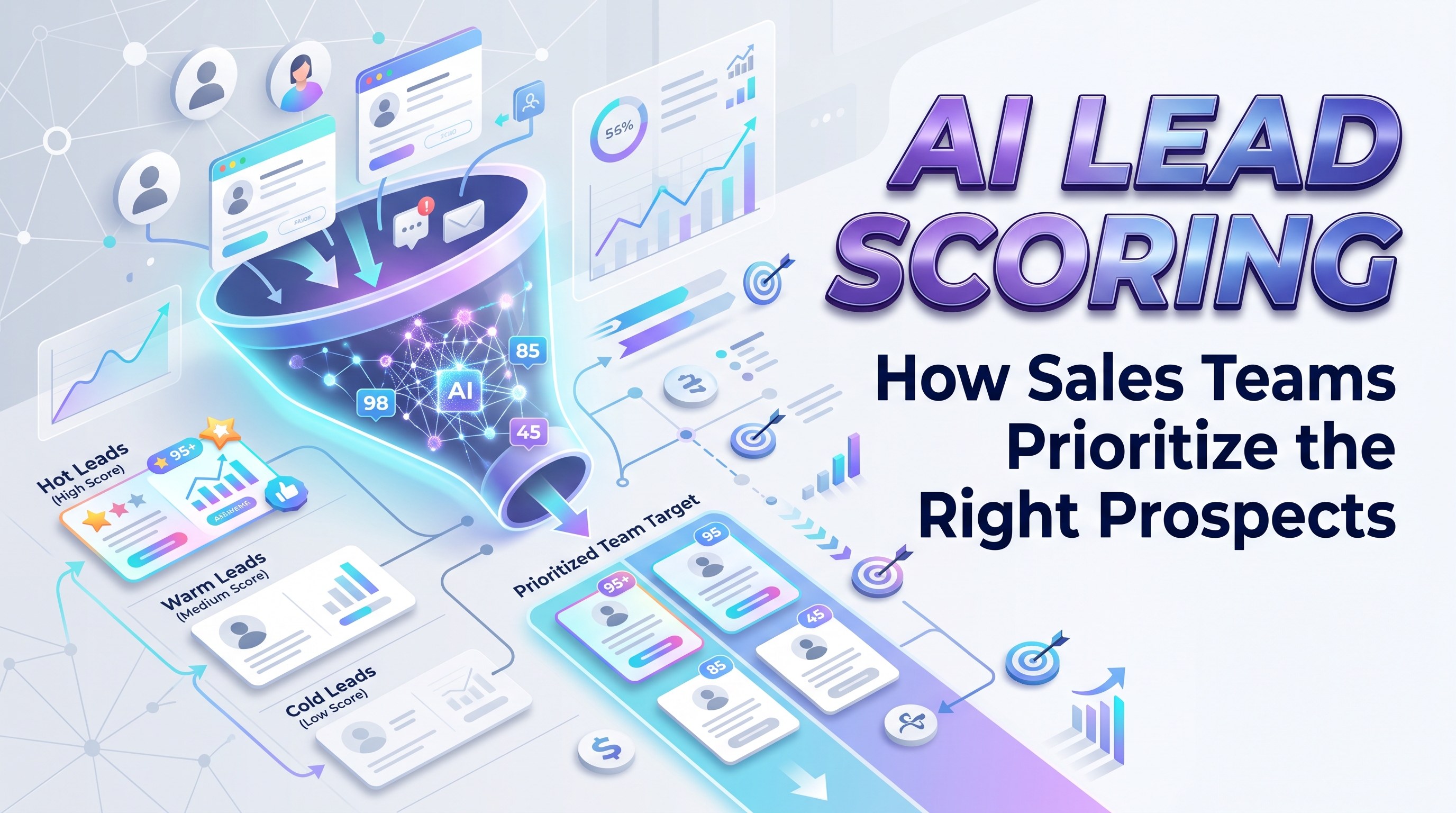
Your Reps Are Chasing the Wrong Leads
Ask any sales manager where the week went and you will hear the same story: reps spent hours on prospects who were never going to buy, while hot leads sat untouched in the CRM. The problem is not effort. It is prioritization. Human lead scoring — gut feel, newest-first, loudest-first — breaks down the moment volume grows. AI lead scoring replaces guesswork with a model that ranks every prospect by likelihood to convert, so reps always know who to call next.
The math is unforgiving. If a rep can meaningfully work thirty leads a week and the CRM holds three thousand, the ordering of that list is the entire game. A ten percent improvement in prioritization compounds into real pipeline within a quarter.
How AI Lead Scoring Actually Works
The model learns from your history. It ingests your past leads with their outcomes — which ones became customers, which went cold — along with their attributes: company size, industry, job title, source channel, website behavior, email engagement, and demographic fit. Machine learning finds the patterns humans miss: maybe leads from a particular integration partner close at triple the rate, or prospects who visit the pricing page twice in a week are five times more likely to buy.
Modern scoring blends two signal families. Fit signals describe who the prospect is — firmographic and demographic match to your ideal customer profile. Intent signals describe what they are doing right now — content downloads, trial activity, repeat visits, email replies. AI weighs both together and outputs a score, usually 0 to 100, plus the top reasons behind it. That explainability matters: reps trust scores they can understand.
What Good Training Data Looks Like
You need history. A few hundred closed-won and closed-lost records is the practical minimum; more is better. The data must be clean — consistent stage definitions, deduplicated contacts, and outcome labels you trust. If your team marks every lost deal as closed-lost without a reason, the model learns noise. Spend the unglamorous weeks fixing CRM hygiene first. It is the highest-leverage step in the whole project and the one most teams skip.
Deploying Scoring Into the Sales Workflow
A score sitting in a dashboard nobody opens is worthless. Push scores directly into the CRM views reps already live in, and sort their task queues by score automatically. Route high-score inbound leads to senior reps within minutes — speed to lead still dominates conversion. Trigger plays by score band: personal outreach for the top tier, automated nurture for the middle, and suppression for the bottom so marketing stops spending on dead ends. Our AI and machine learning solutions practice wires this directly into HubSpot and Salesforce, so scoring becomes invisible infrastructure rather than another tab.
Keeping the Model Honest
Markets shift and models drift. A scoring model trained on last year's buyer can quietly decay as your ICP evolves. Retrain quarterly on fresh outcomes, and monitor the basics: is the top score band still converting at a multiple of the bottom band. Keep a human override path — reps should be able to flag mis-scored leads, and those flags become training data. The goal is a system that improves every quarter, not a black box everyone learns to ignore.
Build, Buy, or Hybrid
HubSpot and Salesforce both ship native predictive scoring that is genuinely good for standard B2B motions — turn it on before you build anything custom. Go custom when your buying signals are unusual: usage data from your product, partner referral patterns, or industry-specific triggers the native tools cannot see. The hybrid path is common: native scoring as the baseline, custom models layered on for your unique signals. Do not pay for custom work until you have proven the native option insufficient.
Scoring for Different Sales Motions
Not every sales team works the same funnel. Inbound teams need instant scoring the moment a lead arrives, because minutes matter more than perfect precision — route fast and let the model refine. Outbound teams use scoring differently: to rank target account lists and decide which prospects deserve deep research versus a light touch. Product-led motions blend product usage signals — feature adoption, seat expansion, integration connections — with firmographic fit, and the score often triggers the sales conversation itself. Account-based teams score at the account level first, rolling up individual contact signals into one account score that tells the team where to focus the quarter. The underlying technique is the same; the deployment changes with the motion.
What to Expect
Plan six to ten weeks including the data cleanup phase. Teams typically see reps spending their time on two to three times more qualified conversations, shorter sales cycles on prioritized leads, and cleaner pipeline reviews because the score gives managers an objective starting point. The cultural shift matters as much as the math: scoring ends the argument about which leads deserve attention. Managers stop debating gut feelings in pipeline reviews and start coaching on the conversations that scores say should have converted but did not. That single change — from arguing about lead quality to coaching on execution — is often worth as much as the prioritization itself.
Ready to Score Your Pipeline?
If your reps are working leads alphabetically or by gut feel, you are leaving pipeline on the table every single week. Book a discovery call and we will assess your CRM data, estimate the lift, and propose a scoring rollout scoped to your sales motion.