Here is the most expensive sentence in sales: we never got back to them in time. Leads go cold in hours, not days, yet most businesses still rely on someone noticing a new inquiry and remembering to reply. An automated follow-up system fixes this permanently — every lead gets an instant, professional response and a structured nurture path, whether it arrives at noon or midnight.
Where Leads Actually Die
Leads rarely die from a bad product. They die in the gaps. The inquiry that arrives on Friday evening and waits until Monday. The website form submission that lands in an inbox nobody monitors. The trade-show list that sits in a spreadsheet for three weeks. The referral that gets one call, no answer, and never a second attempt.
Research consistently shows that responding within minutes makes conversion dramatically more likely than responding within hours — yet the average business takes far longer. The gap between buyer expectation and business reality is where revenue quietly leaks away, month after month.
Anatomy of an Automated Follow-Up System
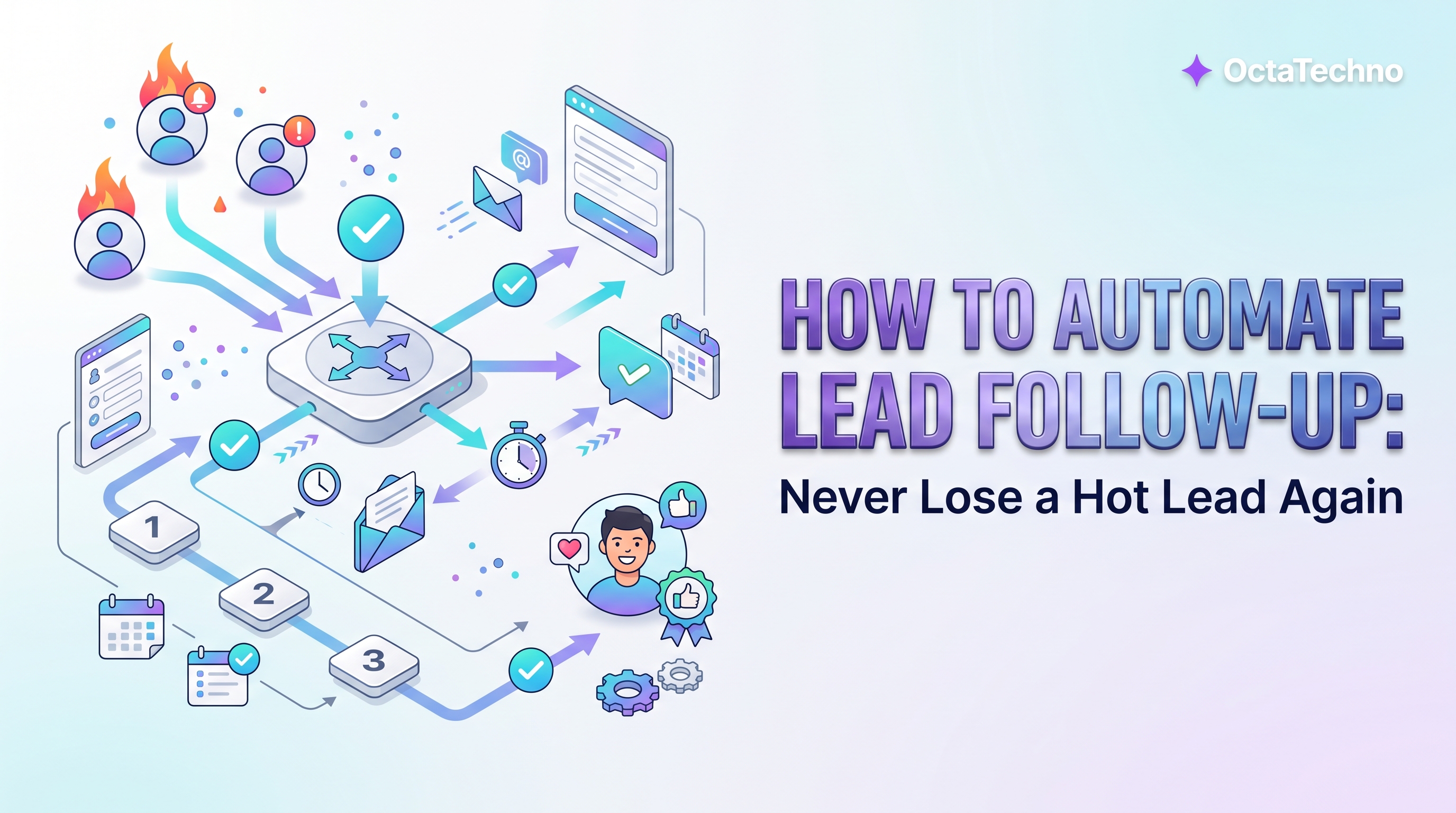
A complete system has five parts working together. First, instant acknowledgment: the moment a lead arrives, they receive a personal-feeling confirmation that sets expectations about what happens next. Second, enrichment: the system fills in company, role, and context from the email or phone number so your team never works blind.
Third, intelligent routing: the lead goes to the right person immediately — by territory, product interest, deal size, or round-robin. Fourth, a nurture sequence: a series of well-timed, genuinely useful touchpoints for leads that are not ready to buy today. Fifth, escalation alerts: if a high-value lead goes quiet or a hot lead is not contacted within your target window, someone gets notified before it is too late.
Build It Step by Step
Step 1: Capture everything centrally.
Every form, ad platform, chat widget, and inbox must feed one CRM. Leads scattered across tools are leads you cannot follow up systematically.
Step 2: Send the instant response.
Within a minute of arrival, the lead gets a message confirming receipt and stating exactly what happens next and when. This single step outperforms every other optimization.
Step 3: Enrich automatically.
Append firmographic and contact data so routing and personalization work from the first touch. Your sales team should never have to Google a prospect before a call.
Step 4: Score and route.
Assign points for fit (right industry, right size, right role) and behavior (visited pricing page, downloaded a guide). Hot leads route to senior reps instantly; cooler leads enter nurture.
Step 5: Run the nurture sequence.
A short series of emails or messages spaced over two to three weeks, each delivering something useful — a case study, a comparison, answers to common objections. Every message earns the next one.
Step 6: Enforce the human handoff.
Automation handles the first mile; humans close. Set a clear service target — for example, personal contact within one business hour for hot leads — and alert a manager automatically when it slips.
Lead Scoring Without Overcomplicating It
Revisit scores quarterly. A source that sent great leads last year may have decayed, and a new campaign may deserve its own scoring rules. Scoring is a living system, not a one-time setup.
Teams often stall here waiting for a perfect model. Start embarrassingly simple: ten points for matching your ideal customer profile, ten for high-intent behavior like a pricing page visit, minus fifteen for a free email domain on an enterprise product. Review monthly and adjust. A simple scoring system you actually use beats a sophisticated one that never launches.
Making Automation Feel Personal
The difference between automation that converts and automation that irritates is personalization done right. Use the enriched data from step three: reference the prospect's industry, mention the specific page or ad they came from, and tailor the call to action to their situation. A message that says we help logistics companies cut data entry time lands completely differently from a generic we help businesses save time.
Timing personalization matters too. A prospect who downloaded a pricing guide at 9am is in research mode; one who requested a demo at 4pm wants a conversation. Your sequences should branch on these behaviors rather than blasting everyone down the same path. Modern CRMs and automation platforms make behavioral branching straightforward — the hard part is thinking through the branches in advance, which is exactly what a proper design workshop covers.
Finally, write like a person. Short sentences. One idea per message. A clear next step. Read every template aloud before activating it; if it sounds like a robot wrote it, rewrite it until it sounds like your best rep on their best day.
Mistakes That Destroy Trust
Three errors undo good automation. The first is robotic messaging — if your instant reply reads like a machine wrote it, prospects disengage. Write every template the way your best salesperson talks. The second is no exit: every sequence needs a clear, honored opt-out, or you become spam. The third is the abandoned handoff — automation that promises a call tomorrow must trigger a task that actually happens tomorrow.
Getting this right across forms, CRMs, and messaging tools takes careful integration work. Our lead intake and enrichment service builds exactly these systems: instant response, automatic enrichment, smart routing, and nurture sequences wired into the CRM your team already uses.
Losing leads to slow follow-up? Claim your free OctaTechno discovery call now. We will audit your current lead flow, find where prospects are slipping away, and design an automated system that responds in minutes, every time.