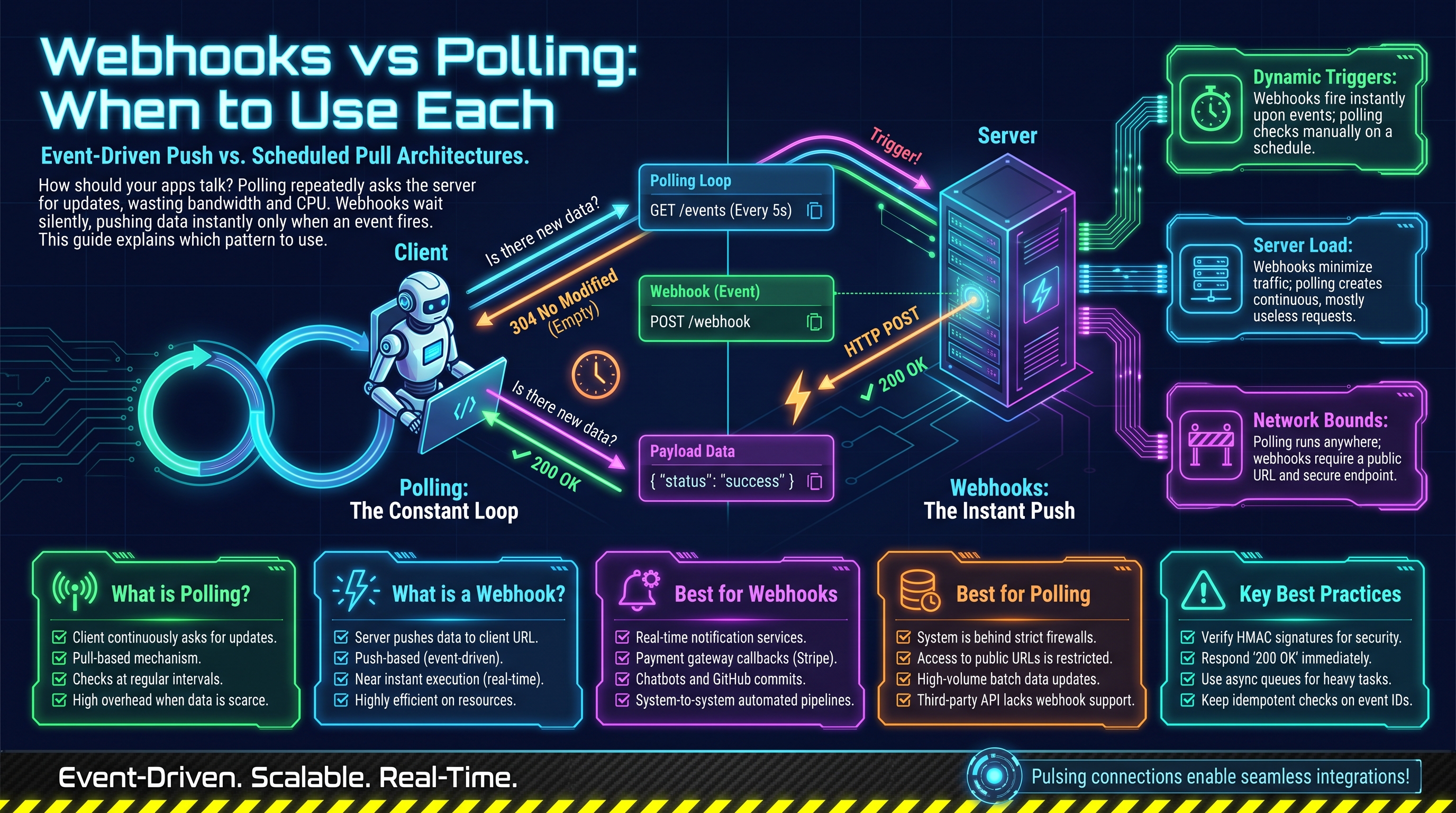
The Core Difference
Your integration needs to know when something changes in another system. There are two ways to find out:
- Polling: you ask repeatedly — "anything new? anything new? anything new?" — on a schedule.
- Webhooks: the other system tells you — it sends an HTTP request to your URL the instant something happens.
It's the difference between refreshing your email every minute and getting a push notification. Both work; they have very different trade-offs.
Polling: Simple but Wasteful
import time

while True:
    orders = api.get("/orders", params={"since": last_check})
    for order in orders:
        process(order)
    last_check = now()
    time.sleep(60)  # check every minute
Advantages:
- Dead simple to implement — just a loop and a timestamp
- Works with any API, even ones without webhook support
- You control the pace; easy to stay within rate limits
- Easy to backfill — "give me everything since Tuesday" just works
Disadvantages:
- Latency: with 60-second polling, you're up to a minute late on every event
- Waste: 99% of polls return "nothing new" — burned API calls and compute
- Rate limits: frequent polling across many resources can exhaust your quota
- Missed changes: if a record changes twice between polls, you may only see the final state
Webhooks: Fast but Demanding
Advantages:
- Near-zero latency: notified in seconds, not minutes
- Efficient: zero traffic when nothing happens
- Complete: every event delivered individually, nothing missed between checks
Disadvantages:
- You need a public URL: the sender must reach your server — no localhost
- You must handle failures: what if your server is down when the event fires? You need retry/dead-letter logic
- Security burden: verify signatures, use HTTPS, guard against replay attacks
- Ordering isn't guaranteed: events can arrive out of order over the network
- Not all APIs offer them
Verifying Webhook Signatures
The most common webhook mistake is trusting any POST that hits your endpoint. Anyone who guesses the URL can inject fake events — and fake "payment succeeded" events are a real attack. Every serious provider (Stripe, GitHub, Shopify) signs payloads with HMAC. Verify the signature before doing anything else:
import hmac, hashlib

def valid_signature(payload: bytes, signature: str, secret: str) -> bool:
    expected = hmac.new(secret.encode(), payload, hashlib.sha256).hexdigest()
    return hmac.compare_digest(expected, signature)  # timing-safe
Three rules. Verify against the raw request body, not parsed JSON — whitespace differences break the hash. Use compare_digest, not ==, to prevent timing attacks. And reject mismatches immediately with a 401. Also guard against replays: most signatures embed a timestamp, so reject anything older than five minutes. An attacker who captures a valid "refund issued" webhook should not be able to replay it tomorrow.
Decision Framework
Use webhooks when:
- Latency matters — instant lead follow-up, fraud alerts, real-time notifications
- Event volume is bursty — long idle periods punctuated by spikes
- The API supports them reliably with signatures and retries
- You're building customer-facing features where speed is the product
Use polling when:
- The API doesn't offer webhooks (still common in legacy/enterprise systems)
- Latency of minutes is acceptable — nightly reports, daily syncs
- You need historical backfill or full-state reconciliation
- Simplicity beats elegance — a cron job you understand beats a webhook system you don't
The Hybrid Approach (Best of Both)
Production systems often use both: webhooks for real-time reaction, plus a periodic polling sweep (hourly or daily) to catch anything the webhooks missed. Webhook deliveries can fail — networks blip, servers restart. The polling sweep is your safety net, reconciling state and filling gaps.
This pattern — real-time push with batch reconciliation — is how serious integrations stay reliable without constant babysitting.
Ordering, Duplicates, and Exactly-Once Processing
Webhooks arrive at-least-once and out of order. A provider may deliver "order updated" twice, or deliver the "shipped" event before the "paid" event. Design for it. Store every incoming event ID in a table with a unique constraint — duplicates get rejected by the database, not by your application logic. For ordering, carry a version or timestamp on each event and ignore stale ones: if the stored record's updated_at is newer than the event's, skip it. Never assume event N+1 means you've seen event N — the missing one may be sitting in a retry queue.
The practical pattern: the webhook handler does three things — verify the signature, dedupe by event ID, enqueue. A background worker then applies events in version order. This keeps your endpoint fast (providers time out slow endpoints and retry, which creates even more duplicates) and your state correct. Exactly-once delivery doesn't exist; idempotent processing is how you fake it convincingly.
Cost Comparison
For a system checking 10 resources: polling every minute means 14,400 API calls/day even when nothing changes. Webhooks mean ~0 calls on quiet days. At scale, or against APIs with tight rate limits, webhooks aren't just faster — they're the only viable option. Conversely, for a once-daily sync, polling is one API call a day: webhooks would be over-engineering.
Designing event-driven integrations — webhooks, queues, and reconciliation sweeps — is something we do regularly. OctaTechno's integration architects can design the right pattern for your systems. Start the conversation.
Webhook Endpoint Best Practices
Your endpoint has one job: accept the event fast and get out of the way. Respond 200 within a couple of seconds — providers like Stripe retry and eventually disable endpoints that respond slowly, so do zero heavy work in the request handler. Push the payload onto a queue and return. Make the handler idempotent from day one, because retries are guaranteed, not exceptional.
Log the raw payload of every incoming event before processing. When a provider silently changes their payload shape, those logs are the only way to reconstruct what happened. Route repeatedly-failing events to a dead-letter queue for inspection instead of letting them vanish. And keep a separate endpoint per provider rather than one generic /webhook — it makes signature verification, logging, and 2 AM debugging dramatically simpler.
Head-to-Head Comparison
- Latency: webhooks win (seconds) vs. polling (minutes, depending on interval)
- Efficiency: webhooks win — zero traffic when idle; polling burns calls constantly
- Simplicity: polling wins — a loop and a timestamp vs. public endpoints, signatures, and retry logic
- Reliability: tie — webhooks need dead-letter handling; polling needs backfill logic; both need monitoring
- Availability: polling wins — works with any API; webhooks require provider support
- Backfill: polling wins — "give me everything since Tuesday" is natural; webhooks only fire going forward
- Cost at scale: webhooks win — dramatically fewer API calls
Beyond the Basics: SSE and WebSockets
Two more patterns worth knowing: Server-Sent Events (SSE) keep a single long-lived connection open for one-way server-to-client updates (live dashboards, progress bars). WebSockets allow full two-way real-time communication (chat apps, collaborative editing, live trading). They're more complex than webhooks but essential when you need continuous bidirectional data flow rather than discrete events.
Implementation Checklist
If you choose webhooks: public HTTPS endpoint, signature verification, immediate 200 response with background processing, idempotency keys to dedupe retries, dead-letter queue for failures, and a periodic reconciliation sweep.
If you choose polling: persistent cursor (last timestamp/ID processed), exponential backoff on errors, jitter to avoid thundering herds, rate-limit awareness, and alerting when polls fail repeatedly.
Polling Smarter: Conditional Requests
Not all polling is dumb polling. Many APIs support conditional requests that make polling nearly as cheap as webhooks: send If-Modified-Since or If-None-Match (ETag) headers, and the API answers 304 Not Modified with an empty body when nothing changed — no JSON parsing, minimal quota burn.
Combine that with adaptive intervals: poll every minute during business hours when changes are likely, back off to every 15 minutes overnight. Add jitter — randomize each interval by ±20% — so a fleet of pollers doesn't stampede the API at the top of every minute (the "thundering herd" that gets integrations rate-limited). And prefer cursor pagination over timestamps where available: "everything after event ID 48291" is immune to the clock-skew and duplicate-delivery issues that timestamp filters suffer from. With these three techniques, polling fifty resources every few minutes costs a fraction of naive polling — sometimes little enough that webhooks aren't worth the operational overhead.
Real-World Scenarios
- New lead → instant WhatsApp message: webhooks. A 5-minute polling delay on a hot lead costs real money.
- Nightly sales sync to accounting: polling. Once a day is plenty; simplicity wins.
- Inventory levels across warehouses: hybrid — webhooks for stock-out alerts, hourly polling for reconciliation.
- Social media mentions: webhooks if the platform offers them; otherwise polling every 15 minutes is fine.
FAQ: Webhooks vs Polling
Can I switch from polling to webhooks later?
Yes — it's a common migration. Keep the polling sweep as your reconciliation layer, add the webhook endpoint alongside it, then lengthen the polling interval once webhooks prove reliable. Never delete polling entirely; it remains your safety net for missed events.
What happens if my webhook endpoint goes down?
Good providers retry with exponential backoff for hours or days (Stripe retries for up to three days). Bad ones fire once and forget. Know your provider's retry policy before relying on webhooks — and run the periodic reconciliation sweep regardless, because it's the only guarantee against silent gaps.
How do I test webhooks locally?
Expose localhost with a tunnel (ngrok, Cloudflare Tunnel) during development, or use the provider's test-event tooling — Stripe CLI's stripe listen --forward-to localhost:3000/webhook replays real event shapes. Never test against production endpoints with real customer data.
Are webhooks always cheaper than polling?
At high event volumes or tight rate limits, yes — dramatically. But a once-daily poll is one API call a day; building signature verification, queues, and dead-letter handling for that is over-engineering. Match the pattern to the frequency, not the fashion.
Most businesses end up with a mix — and that's correct. The art is choosing per integration, not per company. Need help designing an event-driven architecture across your tools? OctaTechno builds real-time automation systems with the right pattern in the right place.