Choosing an automation platform feels like a software decision, but it behaves like an infrastructure decision. The workflows you build become load-bearing: order processing, lead routing, reporting, and customer communication all come to depend on them. Migrating later means rebuilding dozens of workflows under time pressure while the business keeps running. That is why the choice deserves a framework rather than a gut feeling or a feature checklist. What follows is the decision process we use with clients before recommending any platform.
Start With Your Constraints, Not the Feature List
Feature comparisons mislead because every major platform can technically do most things. What actually separates them is how well they fit your constraints. Get these eight on paper before looking at any vendor:
- Technical skill available. Be honest about who will build and maintain workflows. A team with no developers needs a genuinely no-code builder with good templates. A team with one technical person can handle visual logic builders and API configuration. A team with engineers can run self-hosted platforms and write custom code where it pays off. Choosing a developer-grade platform for a non-technical team guarantees stalled adoption.
- Workflow complexity. Simple trigger-to-action flows run fine anywhere. Branching logic, loops, data transformations, and error-handling paths separate the platforms quickly. Sketch your three most complex workflows and check how naturally each candidate expresses them. If a platform needs awkward workarounds for your core logic, it is the wrong platform.
- Volume trajectory. Estimate not just today's runs but next year's. Per-task and per-operation pricing is comfortable at low volume and punishing at high volume. If you expect tenfold growth, price the platforms at that future volume now, because switching later is far more expensive than choosing correctly today.
- Integration depth. Count the systems that matter, then check connector quality, not just connector count. A native connector with full trigger and action coverage beats a generic API wrapper you must configure by hand. Pay special attention to your CRM, ERP, and helpdesk: shallow connectors here create daily friction.
- Data residency and compliance. If you handle regulated data, the platform's hosting regions, encryption, access controls, and certifications are disqualifiers, not nice-to-haves. Self-hosted options exist precisely for teams that cannot send data to third-party clouds.
- AI requirements. Decide whether you need AI steps inside workflows, summarization, classification, extraction, generation, or full agentic behavior. Native AI nodes with proper model choice and cost visibility beat bolted-on AI features every time.
- Governance needs. One person automating is a hobby; twenty people automating is an IT function. Version history, environment separation, approval flows, audit logs, and usage visibility become essential as adoption spreads. Platforms aimed at individuals often lack all of these.
- Total budget reality. Include licenses, implementation effort, training, and maintenance hours, not just the subscription. A cheaper platform that needs a consultant for every change is not cheaper.
The Platform Archetypes
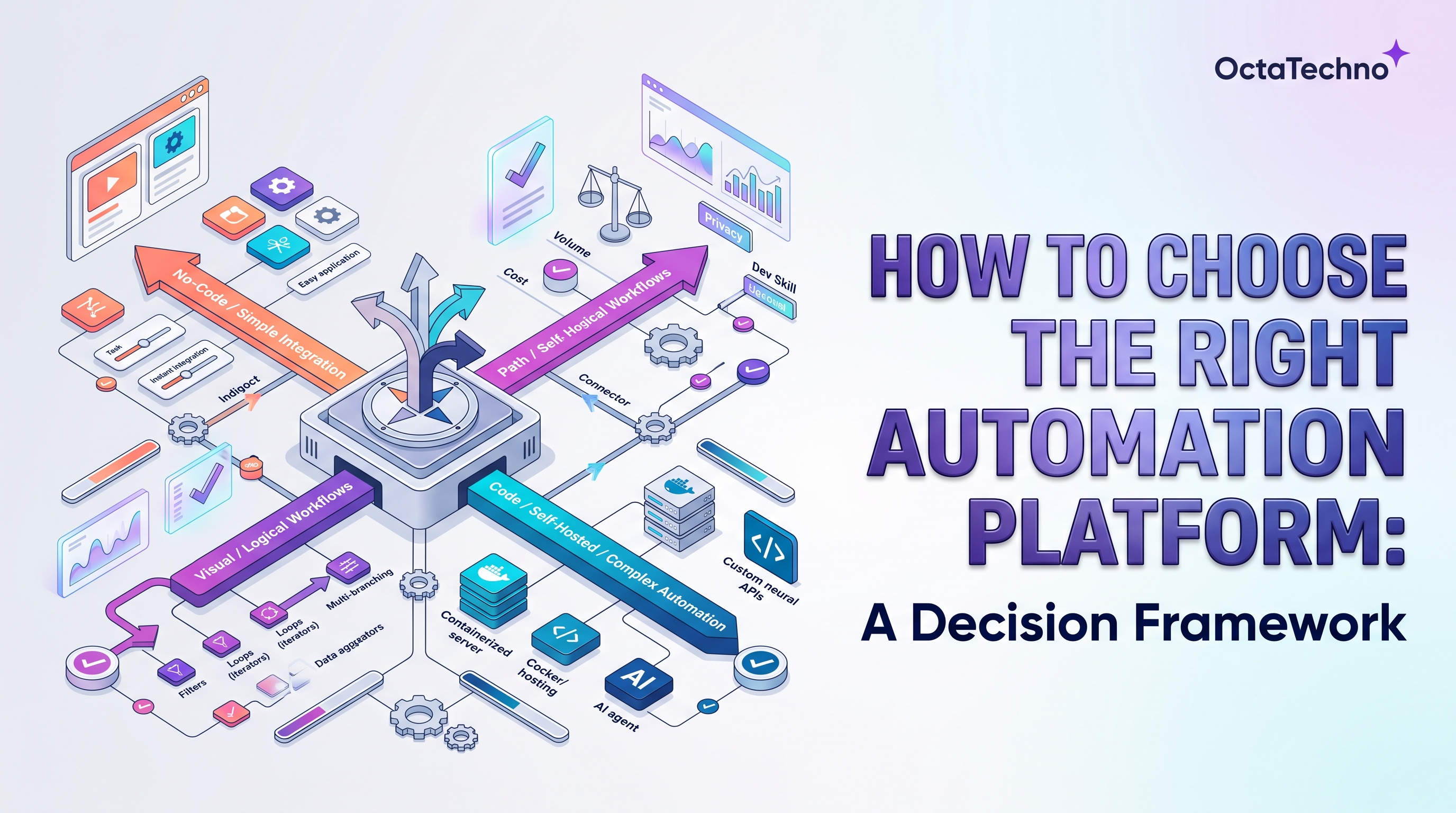
Most options fall into five archetypes. No-code platforms prioritize ease and app breadth for business users. Visual builders trade some simplicity for far better handling of complex logic at moderate cost. Developer platforms offer maximum control and the best economics at scale, in exchange for technical overhead. Enterprise integration platforms add governance, security, and managed connectors for large organizations. Robotic process automation suits legacy systems with no APIs, where software must drive interfaces like a human would. Most mid-sized businesses land on either a visual builder or a developer platform, depending on criterion one above.
Score It Like an Engineer
Turn the eight criteria into a weighted scorecard. Assign each criterion a weight from one to five based on your situation, score each platform from one to five per criterion, and multiply. The exercise forces explicit trade-offs: a team that weights ease-of-use at five and volume at two will get a different winner than the reverse, and both answers can be correct for their respective teams. Do this with the actual builders in the room, not just leadership, because the people living in the platform daily feel constraints that slide decks miss.
Then run a pilot, not a proof of concept. Build one real production workflow, the annoying one everyone complains about, on your top two candidates. Measure build time, run reliability over two weeks, debugging experience when something breaks, and the actual consumption cost. Pilots reveal what scorecards cannot: how the platform feels under real operational load.
Mistakes We See Repeatedly
The most common error is choosing for today's team instead of next year's. A platform that is perfect for one enthusiastic builder becomes a bottleneck when five departments want in. Second is ignoring error handling until production: every platform looks clean in demos and every integration fails eventually, so evaluate logging, retries, and alerting as first-class criteria. Third is underestimating data cleanup. Automation multiplies the speed at which bad data propagates, so plan a data hygiene pass before connecting systems. Fourth is skipping the exit plan. Know how you would export workflow definitions and data before you commit, because the platforms that make leaving hard are telling you something.
Plan for Growth From Day One
Whatever you choose, establish conventions early: naming standards, documentation requirements, a staging area for testing changes, and a single owner per workflow. These habits cost nothing at the start and prevent the tangled mess that forces premature migrations. Review platform fit annually against your volume and complexity growth; the right answer at fifty employees is rarely the right answer at five hundred.
Platform selection is one of the highest-leverage decisions in an automation program, and it is worth getting right the first time. Our IT consulting and support team runs structured platform evaluations, and our AI workflow automation service implements the winner properly, with conventions and governance baked in from the start. Book a discovery call and we will walk your team through the framework against your actual workflows and constraints.