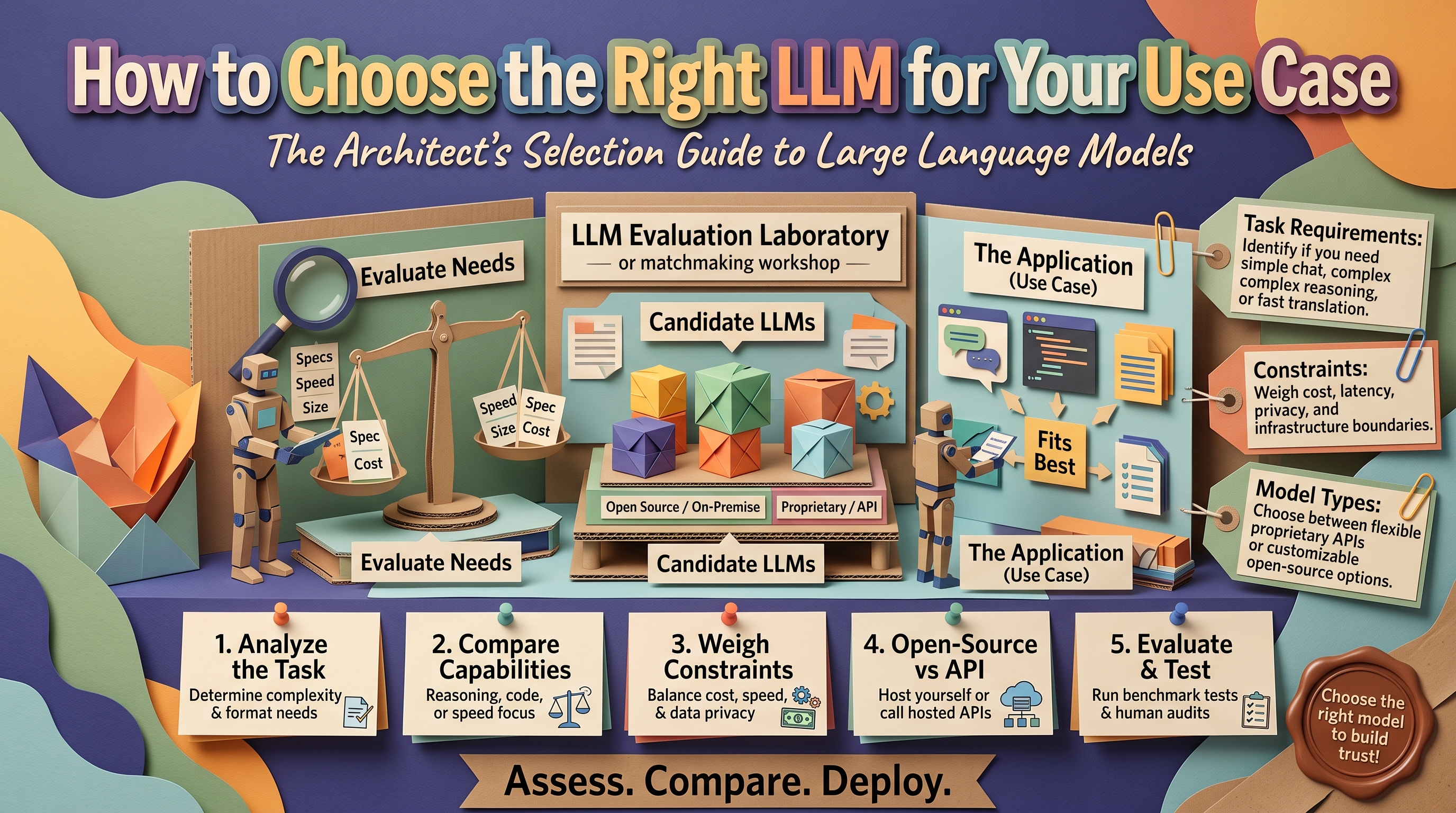
Start with the Job, Not the Model
The most common LLM mistake in business: picking a model first, then finding jobs for it. Someone reads that GPT-4 is "the best," so every task — from classifying support tickets to drafting marketing copy — runs on the most expensive model available. That's like hiring a neurosurgeon to bandage paper cuts.
Different tasks need different models. A support-ticket classifier needs speed and low cost; a contract analyzer needs reasoning depth; a customer-facing chatbot needs safety and tone control. Start by describing the job precisely, then match the model to it.
Six Criteria That Actually Matter
1. Output quality on YOUR task
Benchmarks are marketing. The only quality test that matters is your task with your data. Build a test set of 50–100 real examples, run candidates through them, and score the outputs. A cheaper model that scores 92% on your specific task beats an expensive one scoring 95% — that 3% rarely justifies 10× the cost.
2. Cost per task at scale
Calculate cost per 1,000 tasks, not per token in the abstract. Include input AND output tokens — verbose models cost more on the way out. A task running 100,000 times monthly at $0.01 vs $0.002 per call is the difference between $1,000 and $200/month. At enterprise volumes, model choice is a budget line item.
3. Latency requirements
Real-time chat needs sub-second responses; batch document processing doesn't care if it takes a minute. Smaller models (GPT-4o-mini, Claude Haiku, Gemini Flash) are 3–5× faster than flagships and plenty capable for classification, extraction, and simple generation.
4. Context window vs. retrieval quality
Don't choose a model just for a bigger context window. A 1M-token window is useless if the model can't find the needle in the haystack. For document-heavy work, invest in good RAG retrieval first — it matters more than raw window size for most applications.
5. Data privacy and compliance
Where does your data go? For regulated industries (healthcare, finance, legal), you may need zero-retention agreements, EU/US data residency, or self-hosted open models. This criterion alone eliminates options for some companies — check it before falling in love with a model's capabilities.
6. Ecosystem and tooling
Function calling reliability, structured output support, and framework integrations differ meaningfully. If you're building AI agents that call tools, test each candidate's tool-use accuracy — it's the capability with the widest quality gap between models.
The Decision Shortcut
- High-volume classification/extraction → smallest capable model (mini/flash tier). Test quality first; it's usually sufficient.
- Customer-facing conversation → flagship model from Claude or OpenAI; prioritize tone, safety, and instruction-following.
- Complex reasoning/analysis → top-tier reasoning models; cost matters less when the alternative is expensive human analyst time.
- Bulk document processing → cheapest model that passes your quality bar; volume multiplies every cent.
- Strict compliance needs → filter by data controls first, then pick the best remaining option — or consider self-hosted open models.
A Real-World Example: Support Automation Stack
Here's how this looks in practice for a mid-size SaaS company handling 5,000 support tickets monthly. A small fast model classifies every ticket by topic and urgency (5,000 × $0.001 = $5). A mid-tier model drafts responses using RAG over the help center (5,000 × $0.008 = $40). Only the 300 complex tickets escalate to a flagship model for careful analysis (300 × $0.05 = $15). Total: roughly $60/month in model costs to triage what used to consume 400+ agent hours. Running everything on the flagship would cost 8× more for no meaningful quality gain — the simple tasks never needed the smart model.
Why Smart Teams Use More Than One Model
The winning architecture in 2026 is multi-model: cheap fast models for high-volume simple tasks, flagship models for complex judgment calls, maybe a specialized model for code. A routing layer sends each task to the right model. This typically cuts AI spend 60–80% versus running everything on a flagship — with no quality loss, because each task gets the model it actually needs.
For a head-to-head of the major providers, see our GPT-4 vs Claude vs Gemini comparison.
Score Each Candidate: A Simple Decision Framework
Turn the six criteria into a scorecard. For your specific use case, assign each criterion a weight from 1 (nice to have) to 3 (dealbreaker-level), then score each candidate model 1–5 on every criterion. Multiply, add, and compare — the highest total usually matches your gut, and when it doesn't, the scorecard shows you exactly which tradeoff you're uncomfortable with.
Example: a contract-review assistant. Privacy gets weight 3 (client data can't leave approved infrastructure), output quality weight 3, cost weight 1 (volume is low, stakes are high), latency weight 1, context window weight 2, ecosystem weight 2. A flagship model with zero-retention API terms scores 5s on quality and privacy but 2 on cost — and still wins, because cost barely matters here. Run the same scorecard for a ticket classifier and the weights flip: cost weight 3, quality weight 2, latency weight 3, and a mini-tier model wins by a mile.
The point isn't precision — it's forcing the tradeoffs into the open before you commit. Teams that skip this step almost always overweight "which model is smartest" and underweight "what does this cost at our volume."
Cost and Latency Tiers at a Glance
Exact prices shift constantly, so treat these as orders of magnitude — always check current provider pricing before budgeting:
- Mini/flash tier (e.g., GPT-4o-mini, Claude Haiku, Gemini Flash): roughly $0.15–$0.60 per million input tokens; typical latency 0.3–1 second. The workhorse for classification, extraction, and simple generation.
- Mid tier: roughly $2–$5 per million input tokens; latency 1–3 seconds. A good default for drafting, summarization, and RAG-based Q&A.
- Flagship tier: roughly $10–$30+ per million input tokens; latency 3–10+ seconds. Reserve for complex reasoning, agentic tool use, and high-stakes judgment calls.
Two gotchas: output tokens usually cost 2–4× input tokens, and reasoning models burn far more tokens per answer than their non-reasoning siblings. Always estimate with realistic input/output sizes sampled from your own logs, not the tidy examples in provider marketing.
Common Selection Mistakes
- Chasing benchmark leaderboards. A model that tops general benchmarks can still be mediocre at your specific task — or terrible at following your output format. Your own eval set beats any public benchmark.
- Forgetting output tokens. Teams estimate cost on input tokens, then discover the model's verbose answers triple the bill. Measure tokens per completed task, end to end.
- One model for everything. The single-model architecture is simple to build and expensive to run. Routing each task to the right tier typically cuts spend 60–80%.
- Treating compliance as an afterthought. Discovering your data residency requirements after building on a non-compliant API means rebuilding. Filter on privacy first.
- Ignoring the ecosystem. A slightly weaker model with rock-solid function calling and structured outputs will outperform a "smarter" model that fumbles tool calls inside your agent pipeline.
Evaluate Before You Commit
A proper evaluation takes a day and saves months of regret:
- Build a golden set. 50–100 real inputs with ideal outputs, covering your common cases and your nastiest edge cases.
- Score blind. Have someone rate outputs without knowing which model produced them — brand bias is real, even among engineers.
- Test failure modes, not just averages. A model at 92% average that fails catastrophically on 8% of inputs is worse than one at 90% with graceful degradation.
- Pilot on live traffic. Shadow mode — the new model runs alongside the old one while humans compare — catches what lab tests miss.
- Re-run quarterly. Models get updated, prices change, new options appear. Your model choice should have an expiry date.
Three More Business Scenarios
Legal contract review. A law firm processes 200 contracts monthly. Volume is low, stakes are high, data is confidential. Verdict: flagship model with zero-retention terms, every output reviewed by a lawyer. The model cost is trivial next to the billable hours saved.
Developer code assistant. An agency's 15 developers query it hundreds of times daily. It needs strong code benchmarks and fast responses, but not the absolute top tier. Verdict: a mid-tier model with good coding scores — roughly 3× cheaper than flagship, nearly identical usefulness for boilerplate, debugging, and test generation.
Marketing content at scale. An e-commerce brand generates 500 product descriptions weekly. Verdict: mini-tier model with tight prompts and brand-voice examples, plus a human editor polishing the output. The model drafts; the human differentiates.
Switching Models Later
You will switch models — prices drop, better options appear, providers change terms. Make it cheap: put a thin abstraction layer between your code and the provider's API so swapping means changing configuration, not rewriting logic. Keep prompts as provider-neutral as possible, and keep your golden eval set — re-running it against a new candidate takes an afternoon and tells you exactly what changes. When model-swapping touches many systems at once, that's exactly the kind of plumbing our custom API integration work is designed to handle cleanly.
FAQs
Q: Should we just use the most capable model for everything to keep things simple?
A: Simplicity now, regret later. Running everything on a flagship typically costs 5–10× more than a routed multi-model setup, with no quality gain on simple tasks. The routing layer is a weekend of engineering that pays for itself in the first month.
Q: How often should we re-evaluate our model choice?
A: Quarterly is a good rhythm. The landscape moves fast — today's flagship is next quarter's mid-tier on price. Keep your eval set current and re-run it whenever providers announce major updates or price changes.
Q: Are open-source models good enough for business use?
A: For many tasks, yes — especially classification, extraction, and summarization. The tradeoff is operational: you handle hosting, scaling, and updates. They shine when data can't leave your infrastructure or when volume makes API pricing painful.
Q: What if our data must stay in a specific region?
A: Check each provider's data residency options and zero-retention agreements before anything else — this filter eliminates candidates fast. If no API provider meets your requirements, self-hosted open models on regional cloud infrastructure are the fallback.
Need a model strategy, not just a model? Contact OctaTechno — we architect multi-model AI systems matched to your workloads, quality bars, and budget.